While working on marioseijo.com, I ran into a small decision that changed how I was thinking about analytics.
I was planning to use Google Analytics. It’s free, I already know how to use it, and it can tell me more than I’ll probably ever need to know about the people visiting my site.
But there was a problem.
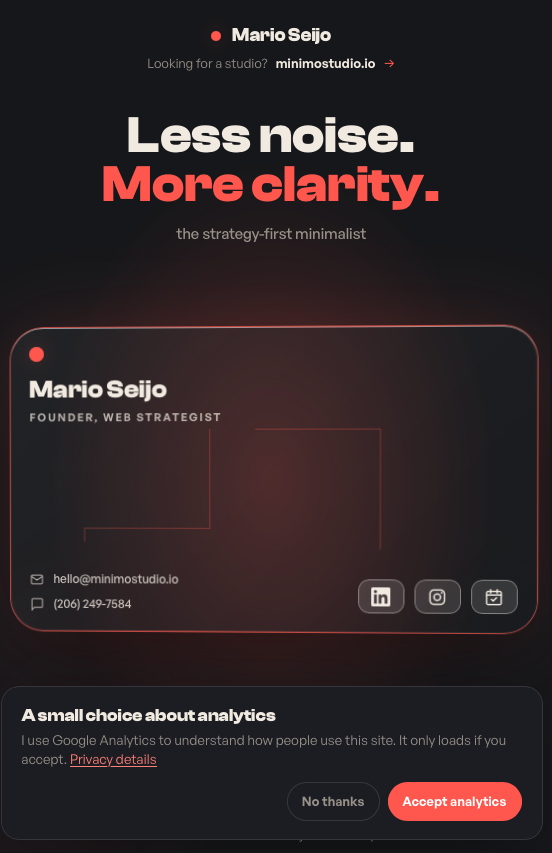
Before Google Analytics could load, I needed to show visitors a consent banner. The first thing someone saw when they arrived was a request to opt in or out of tracking.
It worked. It was also taking attention away from the main message on the page and redirecting it to a consent button.
That didn’t feel right for this site.
Analytics was competing with the page
I’ve been trying to make this website focused and intentional. Every element has a job. I’ve removed things that compete with the main message, even when they’re useful on their own.
The analytics banner created the same problem.
It wasn’t only a visual interruption. I was asking visitors to make a decision about my analytics before they’d had a chance to engage with the site itself.
I want to understand how the site is being used. But that shouldn’t be more important than the experience of the person using it.
I only need enough information to make the site better
The more I thought about it, the more I realized that I don’t need all the information Google Analytics can collect.
For this site, I’m looking for the basics:
- How many people are visiting?
- Which pages are they looking at?
- Where are they coming from?
- Are the changes I make helping?
That’s enough to notice patterns and make better decisions later.
I don’t need to know everything visitors do. I just need enough information to make the site better.
Why I’m trying Plausible
That led me to Plausible Analytics.
Plausible is a simpler, privacy-focused analytics tool. It doesn’t use cookies in its standard setup, which means I can get the basic information I need without putting an analytics consent banner in front of the site’s message.
I hesitated at first because Plausible is paid and Google Analytics is free. I was also leaving a tool I already understood for one I’d have to learn.
Then I found out that Plausible is open source and can be self-hosted.
That got my attention.
I already enjoy running open-source tools in my homelab, so now I want to see what it takes to host Plausible myself and connect it to the site.
I don’t know yet whether it’ll be easy, whether I’ll run into problems, or whether self-hosting it will be worth the extra responsibility. That’s the experiment.
A technical choice can still be a design choice
Switching analytics tools sounds like a behind-the-scenes technical decision. But the reason I’m doing it is the experience on the front end.
The tools running behind a website can change what visitors see, what they’re asked to do, and where their attention goes.
In this case, I’d rather collect less data and keep the experience focused.
Next, I’m going to try self-hosting Plausible and add it to marioseijo.com. I’ll share how the setup goes, what I learn, and whether I decide to keep it.
That’s part of building this site in the open. Not just showing the finished work, but sharing the small decisions that shape it along the way.